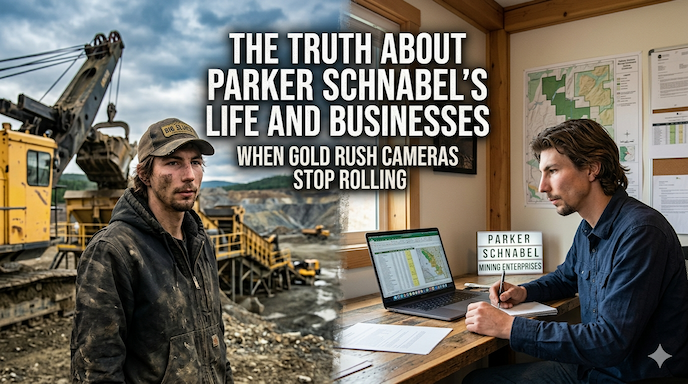
If you’ve spent any time watching Discovery Channel’s Gold Rush, you know Parker Schnabel as the kid from Haines, Alaska who took his grandfather’s mining legacy and turned it into one of the biggest individual gold-mining operations in the Yukon. But here’s the question that pops up every fall when the cameras go dark: what does Parker Schnabel do when not filming Gold Rush?
The short answer will surprise casual viewers. Parker Schnabel doesn’t clock out when the season wraps — he shifts gears. The cameras capture only a slice of what is, in reality, a year-round corporate operation worth millions of dollars. Far from lounging on a beach during the Yukon winter, Schnabel transitions into full-time executive mode, running his commercial mining firm, planning next season’s operations, and even filming international spin-offs.
This deep-dive separates the TV persona from the real business machine operating beneath it — and answers every question Gold Rush fans have been Googling for years.
⚡ Quick Answer — Featured Snippet
When not filming Gold Rush, Parker Schnabel transitions from television personality to full-time corporate executive, overseeing his commercial mining firm, Little Flake Mining. His off-season activities include managing multi-million dollar equipment maintenance budgets, running winter core-drilling exploration programs to map future gold claims, negotiating land lease royalties, and filming his international spin-off series, Gold Rush: Parker’s Trail.
The Off-Season Breakdown: What Parker Schnabel Does in the Winter
Placer mining in the northern Yukon is structurally seasonal. Once temperatures plummet and ground freezes solid, the sluice boxes shut down and the heavy equipment goes cold. But for Parker Schnabel, winter is anything but downtime. It’s the most strategically critical period of his business calendar.
Think of it this way: the mining season is the execution phase. The winter is the planning, engineering, and procurement phase — and without a flawless off-season, the next summer’s gold haul suffers. This is the corporate reality that television editing compresses into a quick montage.
The Winter Drilling and Exploration Programs
One of the most technically demanding off-season activities Parker oversees is the winter drilling program. Crews drill hundreds of test holes into frozen ground — a process called exploration drilling or core drilling — to locate underground gold-bearing gravels called paystreaks.
These pay channels often run deep and follow ancient creek beds that are invisible on the surface. By drilling a grid of test holes and analyzing the core samples, Parker’s team can map exactly where the richest gold concentrations lie before spring breakup. This data directly determines which ground gets worked when the season opens — and in gold mining, working the wrong ground means a disastrously unprofitable year.
The process is expensive, requiring specialized drill rigs capable of operating in sub-zero temperatures, professional geologists to analyze samples, and significant diesel fuel to run camp infrastructure through the winter months.
Equipment Maintenance, Overhauls, and Logistics
Running a Yukon placer mining operation means managing a small fleet of industrial heavy equipment — excavators, wash plants, bulldozers, water pumps, and support vehicles. By the end of a full mining season, that equipment has been pushed hard. The off-season is when every machine gets torn down, inspected, and rebuilt to manufacturer standard.
- Wash plant inspection and overhaul — replacing worn screens, riffles, and sluice mats
- Excavator track and hydraulic system servicing
- Procurement of spare parts and consumables for the upcoming season
- Water infrastructure repairs — hoses, pumps, ponds, and settling systems
- Road and access trail improvements on claim properties
- Fuel supply logistics and winter storage planning
- Payroll and crew management for skeleton winter crews
This level of mechanical maintenance is not cheap. Industry estimates suggest that a full-scale Yukon placer operation like Parker’s can spend several hundred thousand dollars in off-season maintenance alone — before a single ounce of new gold is produced.
“Parker Schnabel does not work a traditional winter job. He acts as the active chief executive of a multi-million dollar mining corporation every single month of the year.”
Securing Mining Claims and Production Royalty Deals (e.g., Little Flake Mining)
Perhaps the least-televised but most financially consequential off-season activity is claim acquisition and royalty negotiation. Parker operates through his wholly-owned company, Little Flake Mining, which functions as the legal entity that signs contracts, acquires mineral rights, and structures the business deals that determine which ground he can mine.
A placer mining royalty agreement is an arrangement in which Parker’s company extracts alluvial gold from ground owned or licensed by a third party, then pays that party a pre-negotiated percentage of the recovered gold value. Structuring these agreements — identifying which claims have genuine gold potential, negotiating royalty rates, performing due diligence on the ground — is sophisticated legal and financial work that happens entirely off-camera.
Major investments like the Dominion Creek operation — one of the largest properties in his portfolio — require extensive off-season planning, environmental permit management, and financial modeling to determine capital deployment for the coming season.

Parker’s Trail: Turning the Off-Season Into Second-Screen Filming
Not all of Parker Schnabel’s off-camera time is spent behind a desk or in a cold equipment yard. A significant chunk of his non-Gold-Rush calendar has been devoted to filming his international spin-off series, Gold Rush: Parker’s Trail — a show that simultaneously serves as genuine business reconnaissance and compelling television content.
The premise of Parker’s Trail is deceptively smart: Parker and a small crew travel to remote corners of the world to explore gold mining traditions, techniques, and potential business opportunities. The locations have ranged from the Australian outback to the jungles of Papua New Guinea to the rivers of South America.
Season 1
Klondike to Australia
Parker traces gold rush history from Yukon roots to Australian goldfields, exploring hard-rock and alluvial operations.
Season 2
Papua New Guinea
A grueling jungle expedition examining artisanal and small-scale gold mining in one of the world’s most remote environments.
Season 3
South America
Parker’s crew explores South American river mining traditions and the geopolitical complexity of gold extraction in the region.
Ongoing
Global Scouting
Each expedition doubles as real-world market intelligence for potential future international mining ventures.
From a business strategy perspective, these expeditions are astute. By filming internationally during off-peak Yukon months, Parker generates a second revenue stream from Discovery Channel licensing while simultaneously conducting research that could inform genuine business expansion. It’s a rare case where reality TV and corporate strategy genuinely overlap.
For fans interested in the broader reality TV landscape, our guide to the top TV shows to binge-watch in 2026 includes several Discovery Channel and documentary-style programs worth exploring alongside Gold Rush.
Parker Schnabel’s Real-World Corporate Portfolio vs. TV Representation
One of the great distortions of reality television is the gap between how a business appears on screen and what it actually is off-screen. Gold Rush is no exception. The show’s editing naturally gravitates toward dramatic visuals — a giant excavator dumping pay dirt, a nerve-wracking gold weigh-in, a mechanical breakdown at the worst possible moment. What it consistently underrepresents is the corporate infrastructure making all of that possible.
| TV Portrayal | Off-Camera Reality |
| “Guy running the bulldozer” | CEO/Owner of Little Flake Mining, a multi-million dollar commercial entity |
| Season-long mining operation | Year-round corporate management with distinct seasonal phases |
| Single primary claim site | Multiple claims including major investments like Dominion Creek |
| Small family-style crew | Structured workforce with foremen, mechanics, operators, and admin staff |
| Spontaneous business decisions | Pre-planned royalty agreements, capital budgets, and geological modeling |
| Exciting gold weigh-ins | One data point in a complex financial model tracking ROI on millions invested |
| On-site problem-solving | Off-season procurement and logistics that prevent most problems in advance |
This gap isn’t a criticism of the show — it’s just the nature of television production. Drama drives viewership; spreadsheets do not. But for fans curious about the true scope of what Parker Schnabel has built, the corporate reality is considerably more impressive than the on-screen narrative suggests.
For context on how other reality TV personalities have built real business empires beyond the cameras, see our feature on celebrities who reinvented their careers with real entrepreneurial pivots.
Where Does Parker Schnabel Live and Relax When Off the Clock?
Beyond the business machinery, fans reasonably wonder about Parker Schnabel’s personal life when the cameras go dark. Where does he actually live? Does he ever genuinely decompress?
Parker was born and raised in Haines, Alaska — a small, remote community near the Alaska-Yukon border with a population of just a few thousand. His family’s deep roots in the area (his grandfather John Schnabel was a legendary local figure and mining pioneer) mean Haines has always been his anchor.
During the summer mining season, he’s based in the Yukon Territory, Canada, living on or near his mining claims for the duration of operations. When the season wraps, he has been known to travel internationally — a pattern reinforced by his Parker’s Trail filming commitments — before returning to the Alaska lifestyle he grew up in.
📍 Parker Schnabel — Where He’s Based
Home base: Haines, Alaska
Mining season: Yukon Territory, Canada (typically May–October)
Off-season travel: International (Australia, Papua New Guinea, South America, and beyond)
Winter disposition: Business management, planning, and personal time in Alaska
By most accounts from interviews and the show itself, Parker is not a conspicuous celebrity lifestyle person. He has spoken openly about preferring the outdoors, small-town life, and the work of the mining operation itself over the trappings of television fame. He’s as comfortable in a truck cab or an equipment yard as in any formal setting — a trait that has earned him genuine respect within the mining community beyond the television audience.
The Financial Stakes: Managing a Multi-Million Dollar Off-Season Budget
Understanding what Parker Schnabel does in his off-season requires understanding the financial scale of what he’s managing. This is not a hobby operation. The numbers involved are significant enough to demand serious year-round executive attention.
~$10M+
Estimated net worth (2026)
$500K+
Annual equipment overhead estimate
2,000+ oz
Typical seasonal gold production target
Millions
Capital deployed at Dominion Creek
The off-season financial workload for an operation of this size includes multiple demanding disciplines simultaneously:
- Fuel procurement: Diesel for excavators, wash plants, and generators represents one of the single largest operating costs. Pre-season fuel purchasing and logistics planning — especially for remote Yukon sites accessible only seasonally — must happen months in advance.
- Land lease and royalty management: Multiple active royalty agreements under Little Flake Mining require ongoing administration, compliance tracking, and renegotiation as production data comes in.
- Payroll continuity: Key personnel — foremen, experienced heavy equipment operators, mechanics — must often be retained on some basis through the winter to prevent losing them to competing operations.
- Capital equipment acquisition: Replacing aging machinery or expanding operations requires sourcing, financing, and scheduling delivery of heavy equipment that can run hundreds of thousands of dollars per unit.
- Geological analysis: Processing and interpreting drilling data from the winter exploration program to build the mine plan for the upcoming season.
- Environmental permitting: Yukon placer mining requires ongoing regulatory compliance and permit renewals that must be managed proactively during the off-season.
It’s worth comparing Parker’s financial management responsibilities to those of other high-profile reality TV entrepreneurs. For similar breakdowns of off-screen business realities, check out our coverage of Bombas’ journey from Shark Tank to billion-dollar success and our analysis of what Gold Rush: White Water’s Dustin Hurt earns per episode — another fascinating look at the financial mechanics behind Discovery Channel’s mining franchises.
Parker Schnabel’s estimated net worth heading into 2026 reflects not just his gold production but his skill at capital allocation — knowing when to invest aggressively in high-potential ground like Dominion Creek and when to pull back from marginal claims. That kind of judgment develops only through years of hands-on financial management, much of it happening entirely off-screen during the months when casual viewers assume nothing is happening.
FAQs
Does Parker Schnabel actually mine when Gold Rush isn’t filming?
Yes — though in a different sense than during the TV season. Active gold extraction pauses when the Yukon freezes, but Parker remains fully engaged in running Little Flake Mining year-round. Winter activities include exploration drilling, equipment maintenance, financial planning, and claim management. When spring arrives and the ground thaws, operations resume whether cameras are rolling or not.
Where does Parker Schnabel spend his winters?
Parker’s home base is Haines, Alaska, where he grew up. His winters are split between business management activities tied to his mining operation, Parker’s Trail filming expeditions to international destinations, and personal downtime in the Alaska lifestyle he prefers. He does not maintain a high-profile urban celebrity lifestyle — he has consistently described himself as most at home in a rural, outdoors-oriented environment.
What business does Parker Schnabel own besides his mining claims?
Parker’s primary business entity is Little Flake Mining, the company that owns or leases his mining claims and signs commercial royalty agreements. His entertainment work — Gold Rush and Parker’s Trail — is managed separately through contracts with Discovery Channel. Beyond these, he has not publicly disclosed significant business ventures outside the mining industry.
How does Parker Schnabel prepare for the mining season during the off-season?
Preparation involves four major pillars: geological (winter drilling programs to locate gold paystreaks), mechanical (full equipment overhauls), logistical (fuel procurement, parts sourcing, crew planning), and financial (royalty negotiations, budget modeling, capital allocation). Each of these tracks runs simultaneously through the winter months, making the off-season arguably the most complex management period of the year.
Is Parker Schnabel’s spin-off show, Parker’s Trail, filmed during the off-season?
Largely yes. Parker’s Trail expeditions are typically filmed during the Yukon’s non-mining months — late fall through early spring — when gold extraction operations are on pause. This allows Parker to travel internationally without abandoning the primary operation. The timing is deliberate: it maximizes his productivity during a period when he cannot be physically mining in the Yukon.
What is the name of Parker Schnabel’s actual mining company?
Parker Schnabel’s commercial mining entity is Little Flake Mining. This is the legal business under which he signs royalty agreements with claim holders, manages assets like the Dominion Creek site, and operates as the primary vehicle for his gold mining enterprise. The company name is often overlooked by viewers who associate his operations purely with the Gold Rush TV brand.
Does Parker Schnabel work a normal winter job?
No. Parker Schnabel does not work a traditional employment-style winter job. He operates as the active owner and executive of Little Flake Mining — a role that encompasses financial management, strategic planning, personnel oversight, and regulatory compliance for a multi-million dollar operation. It is, by any definition, a full-time executive role that happens to operate on a seasonal production calendar.
How does weather affect Parker Schnabel’s mining operations when not filming?
Yukon winters effectively halt surface placer mining by freezing the ground and making water-based processing impossible. This creates a hard seasonal boundary: roughly May through October for active mining, November through April for planning and preparation. The weather-driven shutdown is not a disruption to Parker’s business — it’s a structural feature around which his entire operational calendar is organized.
Who runs Parker Schnabel’s business operations behind the scenes?
Parker himself is the primary decision-maker and owner of Little Flake Mining, but he works closely with a team of experienced foremen, mechanics, and mining professionals. Television editing naturally centers the narrative on Parker personally, but the real operation relies on a crew of skilled individuals whose expertise is critical to the enterprise — many of whom appear briefly on the show but contribute significantly more off-camera.
Related Articles You’ll Enjoy
How Much Does Dustin Hurt Get Paid Per Episode on Gold Rush: White Water?
Juan Ibarra Net Worth in 2026 — The Gold Rush Mechanic’s Journey to Success
Bombas Net Worth in 2026: From Shark Tank Pitch to Billion-Dollar Success
Celebrities Who Reinvented Their Careers — Real Stories of Big Changes
Top TV Shows to Binge-Watch in 2026 — Your Ultimate Streaming Guide